What Is TSA?
The Technology Student Association (TSA) is a national organization for students in STEM where you compete in tech-related events against other schools. Colorado has its own chapter, and this year was my first time participating. I had no idea what to expect going in.
Events range from coding challenges and cybersecurity to video game design and engineering. You pick your events, prepare, and then compete at the regional and state levels. It is genuinely one of the best ways to apply what you are learning in a real competitive setting.
Events I Competed In
I signed up for a few events that lined up with what I have been working on. Here is what I competed in and how it went:
Robotics
This was the event I was most excited about and also the most nervous for. In this competition, participants must design and build a robot and carefully refine its performance. Once the robot is ready, it must be driven through a course with specific obstacles.
The course required the robot to navigate several obstacles, including picking up objects and driving up ramps. One of the most difficult sections involved using the robot's arm to lift pipes. The robot had to slide the pipe upward, drive through it, and repeat this process multiple times. Later in the course, the robot also had to pick up eggs before returning to move the pipes again.
Our team was not able to complete the pipe section successfully because the robot's arm struggled to grip the pipe. However, we were able to complete the rest of the course, which required precise control, coordination, and careful decision-making under pressure.
"Engineering rarely works the first time. The real skill is improving it until it does." — A lesson I learned while preparing for the robotics competition
Senior Solar Sprint
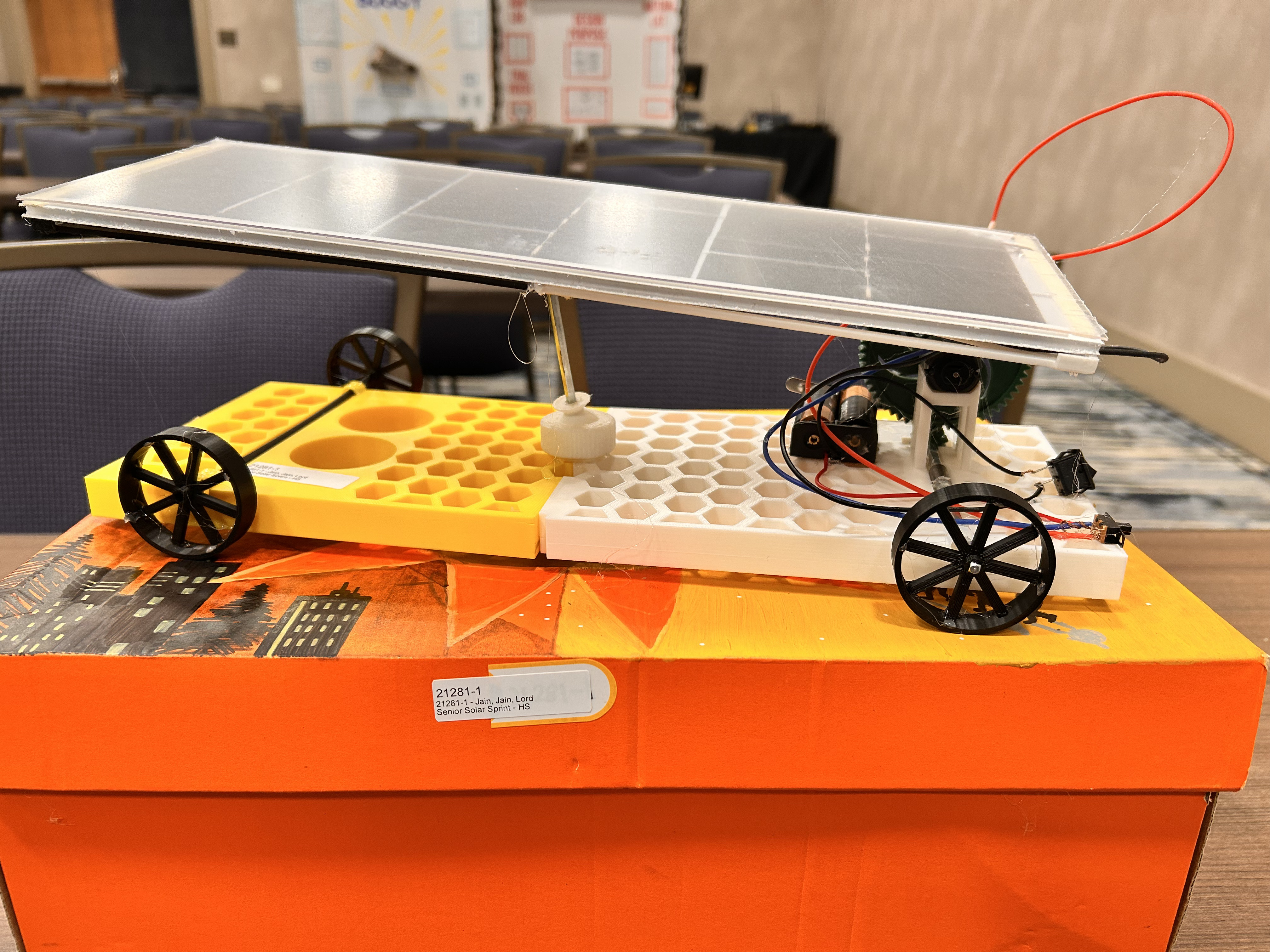
In this event, our team designed and built a solar-powered car. Although the car was well constructed and had a strong design, it did not perform well during the race. The gear ratio we selected was too large, which prevented the motor from generating enough torque to move the car effectively.
Despite this setback, our team interview went well and we were able to clearly explain our design process and what we learned from the experience. In the future, I would improve the design by selecting a smaller gear ratio so the motor can turn the wheels more efficiently.
Drone Challenge UAV
In this event, our team was unfortunately unable to compete because we did not have enough time to build the drone or order the required parts. This experience showed us the importance of planning and preparing early for complex engineering projects.
In the future, we plan to begin designing and ordering components much earlier so we have enough time to build, test, and refine the drone before competition day. With better planning, we hope to fully participate in this event next year.
Coding HS
In this event, my teammate and I had to complete a written test in order to qualify for the state competition. Unfortunately, we did not pass. Our preparation focused mostly on Python, but the exam included questions from several different programming languages. Since most of the questions were not related to Python, we were not fully prepared.
This experience showed us the importance of broader preparation. In the future, we plan to study additional programming languages and review a wider range of programming concepts so we are better prepared for the competition.
Competition Day
Walking into the venue on competition day was a different experience from anything I had done before. Other teams were already setting up, testing robots, and running through last-minute checks. The energy was competitive but also collaborative — everyone was there because they genuinely cared about what they built.
For Robotics, we ran through a few quick test drives in the warmup area before our slot. The pressure of having judges watching and a timer running made it feel completely different from practicing at home. Even small mistakes that we had fixed a dozen times suddenly felt possible again. That pressure was actually one of the most valuable parts of the whole experience.
Results & Placement
I placed in several events at the state level, but did not qualify to advance to nationals. The state competition was a completely different level — the preparation required and the quality of the competitors were both noticeably higher.
Although I did not take first place, the experience gave me a much clearer understanding of what top competitors do differently. Their designs were carefully planned, their systems were well tested, and their interviews were highly professional. Competing at this level gave me valuable experience that I will carry into future competitions.
Biggest Mistakes
Looking back, there were a few clear mistakes that cost us in multiple events. Being honest about them is the only way to actually improve:
- Gear ratio too large for Solar Sprint. We tested the car but never checked whether the motor had enough torque to actually move it under load. A simple bench test would have caught this.
- Did not order drone parts early enough. We knew about the Drone Challenge weeks in advance and still ran out of time. Complex builds need a hard deadline for parts ordering, not a rough idea.
- Only prepared Python for the Coding event. The exam covered multiple languages. One language was never going to be enough.
- Did not test the robot arm enough. The pipe-gripping section was the hardest part of the Robotics course and we had not drilled it nearly enough before competition day.
What I Actually Learned
Beyond the placements, TSA taught me several important lessons that I would not have learned just by building projects at home:
- Small design choices matter. A single decision — like gear ratio — can completely change whether a project succeeds or fails.
- Practice improves control and precision. Successfully navigating the obstacle course required careful coordination and a lot of repetition.
- Preparation needs to be broad. Focusing on only one language or one skill is rarely enough. Competitions test range.
- Planning early is critical. Large builds require early ordering, early testing, and a real schedule — not guesses.
- Explaining your design is part of engineering. Interviews and presentations matter just as much as the build itself.
Tools & Technologies
Here is a quick overview of what we worked with across all four events:
What's Next
Next year, I plan to compete in TSA again with better preparation and a clearer plan. This year taught me a lot — especially about starting early, testing designs more carefully, and preparing broadly for every part of an event. I will use what I learned from my mistakes to improve my projects and my performance.
TSA showed me that every competition is an opportunity to learn and grow. Even when things do not go as planned, the experience pushes you to improve for the next challenge.
This first year of TSA showed me how much preparation, engineering, and teamwork go into real competitions. Next year, I plan to return with better designs, stronger preparation, and a much clearer plan from day one.